

How Can Condensation Help Us Compare Temperatures in Different Rooms?
Sometimes, we can use condensation to figure out which room is cooler or warmer without using a thermometer!
Here’s how:
Imagine placing the same cold glass of water in two different rooms. After a few minutes, you look at the outside of both glasses.
What do you observe? What has happened?
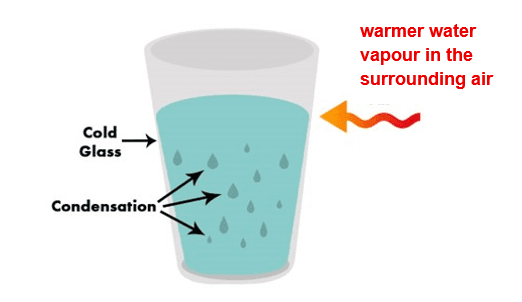
Water droplets formed on the outer surface of the glass.
This is because warmer water vapour in the surrounding air came into contact with the cooler outer surface of the glass, lost heat, and condensed into water droplets.
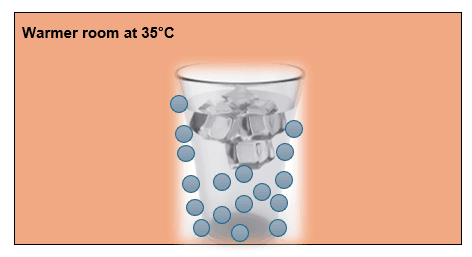
The glass cup with more water droplets on its outer surface is in the **warmer room**.
The glass cup with fewer water droplets on its outer surface is in the **cooler room**.
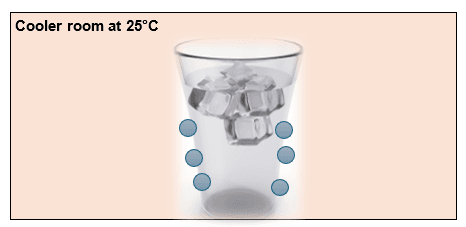
Take note: The temperature of the room is still higher than the surface of the cup, in order for condensation to take place.
What caused the difference in amount of water droplets formed?
In the warmer room, **water vapour is at a higher temperature** in the air. When this warmer water vapour touches the cold glass, the rate of condensation is faster, thus forming more water droplets on the cooler outer surface of the glass.
Take note: The larger the temperature difference between the water vapour and the surface, the greater the rate of condensation.
Here’s another example to check your understanding.
Compare the two scenarios below:
Scenario 1
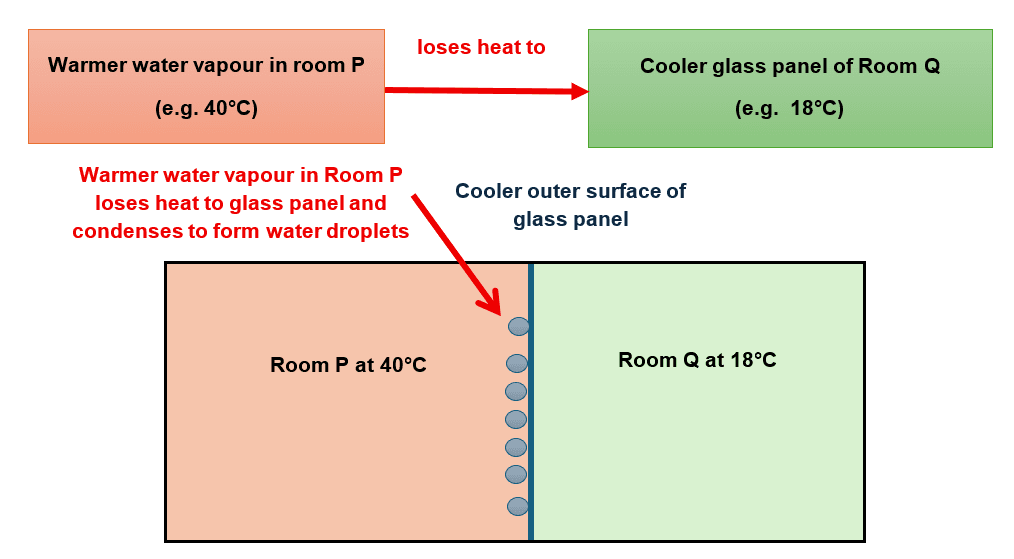
Scenario 2
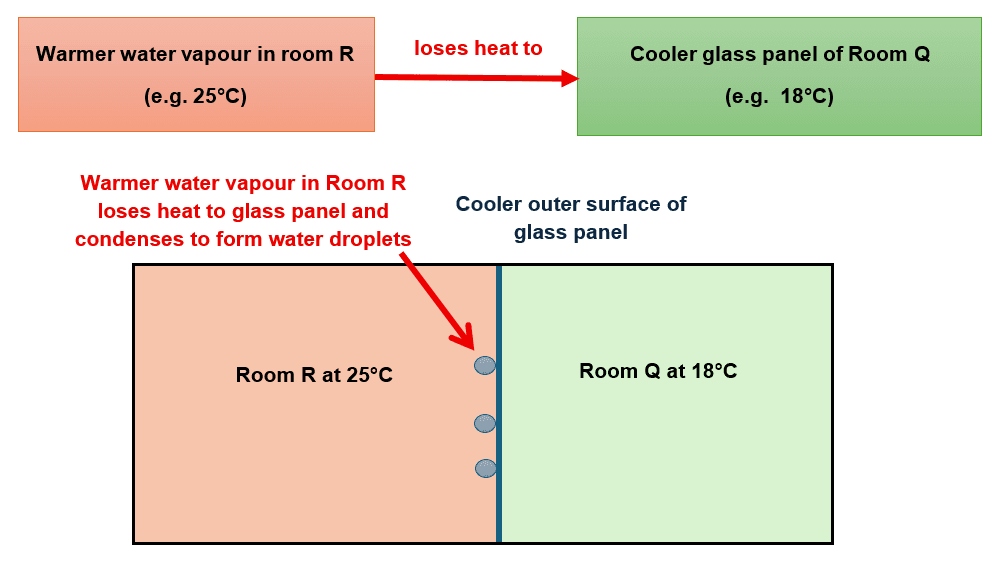
Why is there a difference in amount of water droplets formed on glass panel in Scenario 1 & 2?
Let’s Analyse Each Room:
- Room Q is the coldest (lowest temperature of 18°C). With a higher temperature in Room P (40°C) than Room R (25°C), Room P is warmer than Room R.
- Therefore, in Scenario 1, there is a greater temperature difference between the warmer water vapour in Room P and the cooler glass panel of Room Q: Scenario 1: 40°C – 18°C = 22°C
- In Scenario 2, the temperature difference between the warmer water vapour in Room R and the cooler glass panel of Room Q is only 7°C: Scenario 2: 25°C – 18°C = 7°C
- Therefore, with a higher temperature in room P, the warmer water vapour in room P will lose heat and condense faster into more water droplets.
Condensation can therefore help us infer the temperature of rooms based on observing the amount of water droplets formed on the cooler surface: Room P has the highest temperature, followed by Room R, then Room Q.