

Why students are confused between gravitational potential energy and gravitational force?
This is a common area of confusion for Primary 6 students, especially when the topics Forms of Energy and Forces are taught close together.
Both are key components of the Primary 6 Science syllabus, and a clear understanding of these concepts can greatly boost a student’s confidence and exam performance.
In this guide, your child will learn to:
- distinguish between the two concepts, using relatable analogies, structured explanations, and simple activities to reinforce understanding.
- identify what gravitational potential energy means and when it is present.
- understand what gravitational force is and how it acts.
- know how to apply both concepts in real-world examples and exam questions.
Key Differences
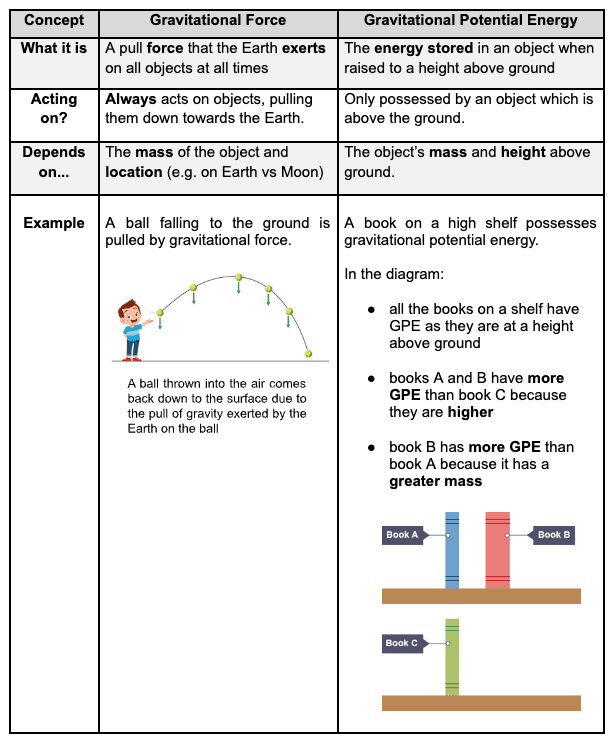
How to Explain to Your Child – Use Analogies!
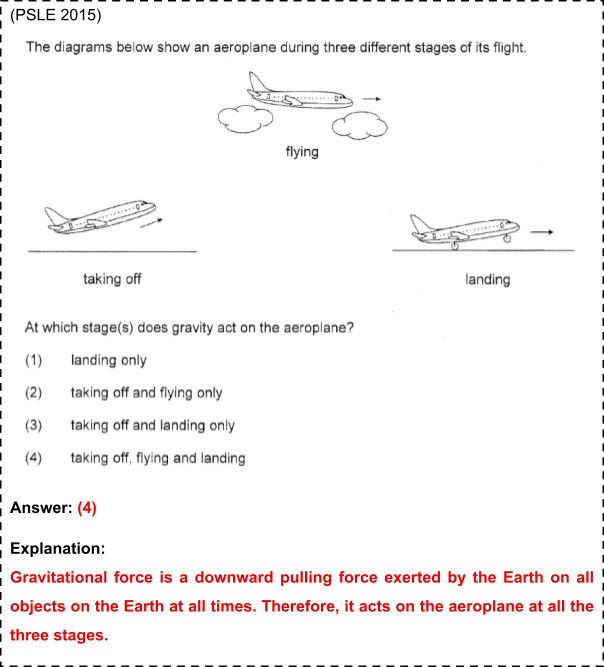
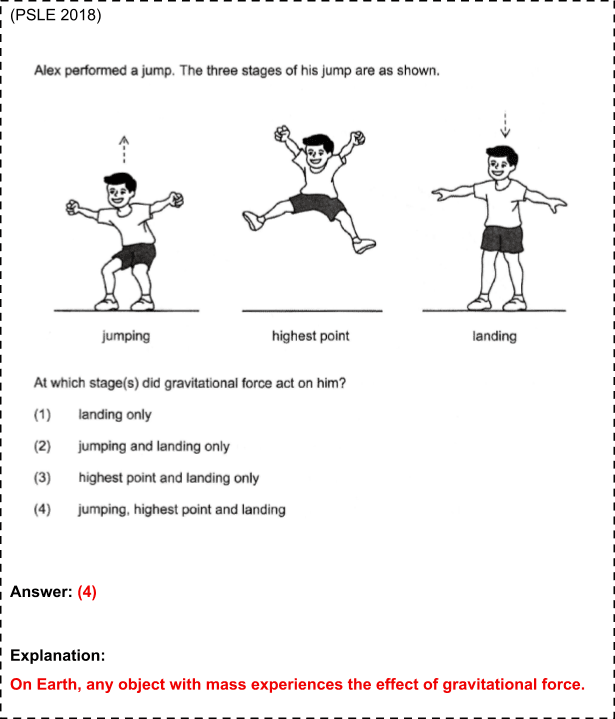
Gravitational Force = Invisible hands of the Earth
Imagine the Earth has invisible hands pulling everything down. That pull is gravitational force.
- It pulls the apple from the tree.
- It pulls your feet to the ground.
- It pulls a parachute down after it is opened.
- It doesn’t store anything — it just pulls!
Gravitational Potential Energy = Energy stored in an object due to its height
Now imagine you lift a heavy bag onto a high shelf.
- You have done work against gravity when lifting a heavy bag onto a high shelf, and this work is stored as gravitational potential energy in the bag.
- The higher the object above the ground, the more stored energy it has. This stored energy is called gravitational potential energy (GPE).
- Once it falls, the (gravitational) potential energy is converted into kinetic energy of the falling bag
(Think of GPE as a battery: The object at a height stores energy ready to be converted when the object falls.)
Example:
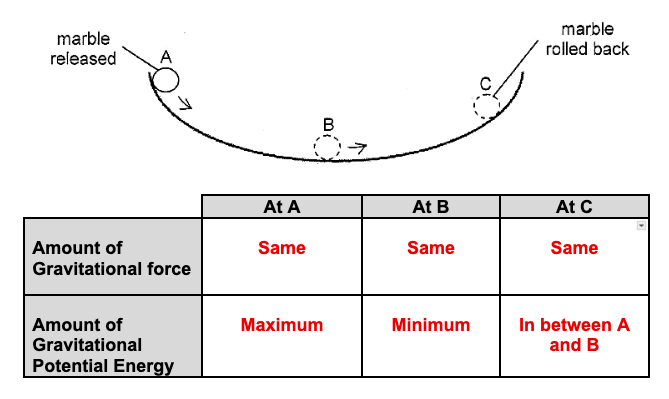
Rachel released a marble at position A in the rough wooden bowl shown below. The marble rolled to position B and then to position C where it rolled back.
Explanation:
At position A (highest position): The marble possessed the greatest amount of gravitational potential energy as it was at the highest position.
Rolling from A to B: The gravitational potential energy had been converted into kinetic energy, sound and heat energy.
At position B (lowest position): It possessed the least amount of gravitational potential energy as it was at the lowest position but it possessed the greatest amount of kinetic energy.
Rolling from B to C: Kinetic energy had been converted into gravitational potential energy, sound and heat energy.
Common misconceptions to watch out for:
(✔) Correct: It’s always acting on an object with mass, even when the object is not moving.
(X) Wrong: Gravitational force only happens when things fall.
(✔) Correct: Even light objects have GPE, as long as they’re above ground!
(X) Wrong: Only heavy things have GPE
Note: Lighter objects (smaller mass) have less GPE than heavier objects.
Question that students can ask themselves when attempting questions:
“Is this about a pull force or about stored energy?”
This simple question helps separate the two ideas clearly.