
Water Cycle & Changes in States (Condensation)
Why Condensation Matter in Science and Everyday Life
Condensation is a science concept your child will encounter in the Primary 5 topic, Water and Changes of State, which is closely linked to the understanding of Primary 4 topic, Heat & Temperature.
Many students tend to confuse condensation with evaporation or assume it only happens when things “cool down”. Understanding condensation helps in tackling open-ended questions on the water cycle, effects of heat and changes of state.
In this guide, your child will:
- learn to understand what condensation is, when it happens, and why it’s important
- learn more about real-life examples and conduct simple activities which can reinforce learning.
What is Condensation?
- Condensation happens when a gas loses heat and changes into a liquid.
- It usually occurs when warmer water vapour (gas) in the surrounding air came into contact with a cooler surface (or cooler surrounding air) and loses heat. (Note: This means that the cooler surface (or cooler surrounding air) gains heat from the warmer water vapour)
- As the warmer water vapour loses heat to the cooler surface (or cooler surrounding air), the gas changes into liquid, turning into tiny water droplets, and condensation has taken place!
Why is that so?
(✔) Correct: The warmer water vapour loses heat to the cooler surface and changes its state from gas to liquid.
(X) Wrong: The cooler surface loses heat to the warmer water vapour.
Recall the concept from Primary 4’s Heat & Temperature topic:
Heat flows from hotter to colder objects/regions until both reach the same temperature.

Real-Life examples that your child can relate to
Example: Water droplets on the outside of a cup of iced water (Note: It’s not water in the cup “leaking”!)
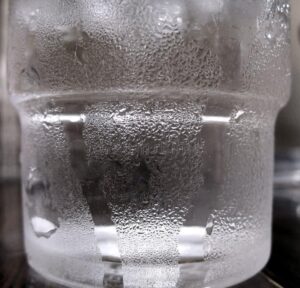
Explanation: Warmer water vapour in the surrounding air came into contact with the cooler outer surface of the cup, lost heat and condensed to form water droplets on the outer surface of the cup.
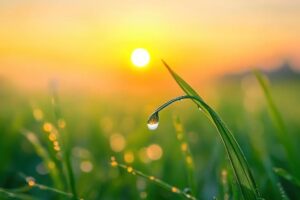
Example: Morning dew on grass
(Note: It did not rain.)
Explanation:
At night, the air cools and the grass blades cools. In the morning, warmer water vapour in the air came into contact with the cooler surface of the grass blades, lost heat and condensed to form water droplets on the grass, known as dew.
Experiment: Try This at Home (with parental supervision)
You’ll need:
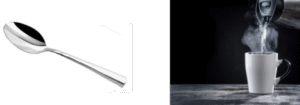
- A cold metal spoon
- A kettle or cup of hot water
Steps:
1. Hold the cold spoon above the cup of hot water.
(However, do not let the spoon touch the water.)
2. Observe what forms on the spoon after some time.
What you’ll observe?
Water droplets will appear on the spoon — that’s condensation!